Teoría: Sistemas de Ecuaciones Diferenciales Ordinarias
3.1 Forma Matricial
Sistema de EDO Lineales
Un sistema de $n$ ecuaciones diferenciales lineales de primer orden:
$$\begin{cases} x_1' = a_{11}x_1 + a_{12}x_2 + \cdots + a_{1n}x_n + f_1(t) \ x_2' = a_{21}x_1 + a_{22}x_2 + \cdots + a_{2n}x_n + f_2(t) \ \vdots \ x_n' = a_{n1}x_1 + a_{n2}x_2 + \cdots + a_{nn}x_n + f_n(t) \end{cases}$$
Notación Matricial
$$\boxed{\mathbf{X}' = A\mathbf{X} + \mathbf{F}(t)}$$
donde: - $\mathbf{X} = \begin{pmatrix} x_1 \ x_2 \ \vdots \ x_n \end{pmatrix}$ es el vector de incógnitas - $A = (a_{ij})$ es la matriz de coeficientes $n \times n$ - $\mathbf{F}(t) = \begin{pmatrix} f_1(t) \ f_2(t) \ \vdots \ f_n(t) \end{pmatrix}$ es el vector de términos forzantes
Sistema Homogéneo
Cuando $\mathbf{F}(t) = \mathbf{0}$:
$$\mathbf{X}' = A\mathbf{X}$$
Conversión de EDO de Orden Superior
Una EDO de orden $n$: $$y^{(n)} + a_{n-1}y^{(n-1)} + \cdots + a_1y' + a_0y = f(t)$$
Se convierte en sistema con: $x_1 = y$, $x_2 = y'$, ..., $x_n = y^{(n-1)}$
Ejemplo: $y'' + 3y' + 2y = 0$
Sea $x_1 = y$, $x_2 = y'$
$x_1' = x_2$
$x_2' = y'' = -3y' - 2y = -2x_1 - 3x_2$
$$\mathbf{X}' = \begin{pmatrix} 0 & 1 \ -2 & -3 \end{pmatrix}\mathbf{X}$$
3.2 Método de Valores Propios (Eigenvalores Reales Distintos)
Idea Central
Buscamos soluciones de la forma:
$$\mathbf{X} = e^{\lambda t}\mathbf{v}$$
donde $\lambda$ es un escalar y $\mathbf{v}$ un vector constante.
Condición
Sustituyendo en $\mathbf{X}' = A\mathbf{X}$:
$$\lambda e^{\lambda t}\mathbf{v} = Ae^{\lambda t}\mathbf{v}$$
$$A\mathbf{v} = \lambda\mathbf{v}$$
Es decir, $\lambda$ debe ser valor propio y $\mathbf{v}$ vector propio de $A$.
Solución General (Caso Reales Distintos)
Si $A$ tiene eigenvalores $\lambda_1, \lambda_2, ..., \lambda_n$ distintos con eigenvectores $\mathbf{v}_1, \mathbf{v}_2, ..., \mathbf{v}_n$:
$$\boxed{\mathbf{X} = C_1 e^{\lambda_1 t}\mathbf{v}_1 + C_2 e^{\lambda_2 t}\mathbf{v}_2 + \cdots + C_n e^{\lambda_n t}\mathbf{v}_n}$$
Ejemplo: Resolver $\mathbf{X}' = \begin{pmatrix} 1 & 1 \ 4 & 1 \end{pmatrix}\mathbf{X}$
Ecuación característica: $$\det(A - \lambda I) = \begin{vmatrix} 1-\lambda & 1 \ 4 & 1-\lambda \end{vmatrix} = (1-\lambda)^2 - 4 = 0$$
$\lambda^2 - 2\lambda - 3 = 0 \Rightarrow \lambda_1 = 3, \lambda_2 = -1$
Eigenvector para $\lambda_1 = 3$: $(A - 3I)\mathbf{v} = 0$: $\begin{pmatrix} -2 & 1 \ 4 & -2 \end{pmatrix}\mathbf{v} = 0$
$-2v_1 + v_2 = 0 \Rightarrow \mathbf{v}_1 = \begin{pmatrix} 1 \ 2 \end{pmatrix}$
Eigenvector para $\lambda_2 = -1$: $(A + I)\mathbf{v} = 0$: $\begin{pmatrix} 2 & 1 \ 4 & 2 \end{pmatrix}\mathbf{v} = 0$
$2v_1 + v_2 = 0 \Rightarrow \mathbf{v}_2 = \begin{pmatrix} 1 \ -2 \end{pmatrix}$
Solución: $$\mathbf{X} = C_1 e^{3t}\begin{pmatrix} 1 \ 2 \end{pmatrix} + C_2 e^{-t}\begin{pmatrix} 1 \ -2 \end{pmatrix}$$
3.3 Valores Propios Complejos
Eigenvalores Complejos Conjugados
Si $\lambda = \alpha + \beta i$ es eigenvalor con eigenvector $\mathbf{v} = \mathbf{a} + i\mathbf{b}$, entonces $\bar{\lambda} = \alpha - \beta i$ también es eigenvalor.
Solución Compleja
$$\mathbf{X} = e^{(\alpha + \beta i)t}(\mathbf{a} + i\mathbf{b})$$
Soluciones Reales
Usando la fórmula de Euler $e^{i\theta} = \cos\theta + i\sin\theta$:
$$\boxed{\mathbf{X}_1 = e^{\alpha t}(\mathbf{a}\cos\beta t - \mathbf{b}\sin\beta t)}$$
$$\boxed{\mathbf{X}_2 = e^{\alpha t}(\mathbf{a}\sin\beta t + \mathbf{b}\cos\beta t)}$$
Solución general:
$$\mathbf{X} = C_1\mathbf{X}_1 + C_2\mathbf{X}_2$$
Ejemplo: $\mathbf{X}' = \begin{pmatrix} 0 & 1 \ -1 & 0 \end{pmatrix}\mathbf{X}$
$\det(A - \lambda I) = \lambda^2 + 1 = 0 \Rightarrow \lambda = \pm i$
Para $\lambda = i$: $(A - iI)\mathbf{v} = 0$
$\begin{pmatrix} -i & 1 \ -1 & -i \end{pmatrix}\mathbf{v} = 0$
$-iv_1 + v_2 = 0 \Rightarrow v_2 = iv_1$
$\mathbf{v} = \begin{pmatrix} 1 \ i \end{pmatrix} = \begin{pmatrix} 1 \ 0 \end{pmatrix} + i\begin{pmatrix} 0 \ 1 \end{pmatrix}$
$\mathbf{a} = \begin{pmatrix} 1 \ 0 \end{pmatrix}$, $\mathbf{b} = \begin{pmatrix} 0 \ 1 \end{pmatrix}$
$\alpha = 0$, $\beta = 1$
Solución: $$\mathbf{X} = C_1\begin{pmatrix} \cos t \ -\sin t \end{pmatrix} + C_2\begin{pmatrix} \sin t \ \cos t \end{pmatrix}$$
3.4 Valores Propios Repetidos
Eigenvalor Doble con Un Solo Eigenvector
Si $\lambda$ es eigenvalor de multiplicidad 2 pero solo hay un eigenvector linealmente independiente $\mathbf{v}$, necesitamos un vector generalizado $\mathbf{w}$ que satisface:
$$(A - \lambda I)\mathbf{w} = \mathbf{v}$$
Solución General
$$\boxed{\mathbf{X} = C_1 e^{\lambda t}\mathbf{v} + C_2 e^{\lambda t}(t\mathbf{v} + \mathbf{w})}$$
Ejemplo: $\mathbf{X}' = \begin{pmatrix} 3 & 1 \ -1 & 1 \end{pmatrix}\mathbf{X}$
$\det(A - \lambda I) = (3-\lambda)(1-\lambda) + 1 = \lambda^2 - 4\lambda + 4 = 0$
$(\lambda - 2)^2 = 0 \Rightarrow \lambda = 2$ (doble)
Eigenvector: $(A - 2I)\mathbf{v} = 0$: $\begin{pmatrix} 1 & 1 \ -1 & -1 \end{pmatrix}\mathbf{v} = 0$
$v_1 + v_2 = 0 \Rightarrow \mathbf{v} = \begin{pmatrix} 1 \ -1 \end{pmatrix}$
Vector generalizado: $(A - 2I)\mathbf{w} = \mathbf{v}$: $\begin{pmatrix} 1 & 1 \ -1 & -1 \end{pmatrix}\mathbf{w} = \begin{pmatrix} 1 \ -1 \end{pmatrix}$
$w_1 + w_2 = 1 \Rightarrow \mathbf{w} = \begin{pmatrix} 1 \ 0 \end{pmatrix}$
Solución: $$\mathbf{X} = C_1 e^{2t}\begin{pmatrix} 1 \ -1 \end{pmatrix} + C_2 e^{2t}\left[t\begin{pmatrix} 1 \ -1 \end{pmatrix} + \begin{pmatrix} 1 \ 0 \end{pmatrix}\right]$$
3.5 Retratos de Fase
Punto de Equilibrio
El punto de equilibrio del sistema $\mathbf{X}' = A\mathbf{X}$ es $\mathbf{X} = \mathbf{0}$ (cuando $\det A \neq 0$).
Clasificación (Sistema 2×2)
Para matriz $A$ con eigenvalores $\lambda_1, \lambda_2$:
| Eigenvalores | Tipo | Descripción |
|---|---|---|
| $\lambda_1 < \lambda_2 < 0$ | Nodo estable | Trayectorias convergen al origen |
| $0 < \lambda_1 < \lambda_2$ | Nodo inestable | Trayectorias divergen del origen |
| $\lambda_1 < 0 < \lambda_2$ | Punto silla | Hiperbólico, inestable |
| $\alpha \pm \beta i$, $\alpha < 0$ | Espiral estable | Espiral hacia el origen |
| $\alpha \pm \beta i$, $\alpha > 0$ | Espiral inestable | Espiral alejándose |
| $\pm \beta i$ | Centro | Órbitas cerradas (elipses) |
| $\lambda_1 = \lambda_2 < 0$, 2 eigenvect. | Nodo estrella estable | Líneas rectas al origen |
| $\lambda_1 = \lambda_2 < 0$, 1 eigenvect. | Nodo degenerado estable | Tangente a una dirección |
Estabilidad
- Asintóticamente estable: $\mathbf{X}(t) \to \mathbf{0}$ cuando $t \to \infty$ (todos $\text{Re}(\lambda) < 0$)
- Estable: Trayectorias permanecen cerca ($\text{Re}(\lambda) \leq 0$)
- Inestable: Algún $\text{Re}(\lambda) > 0$
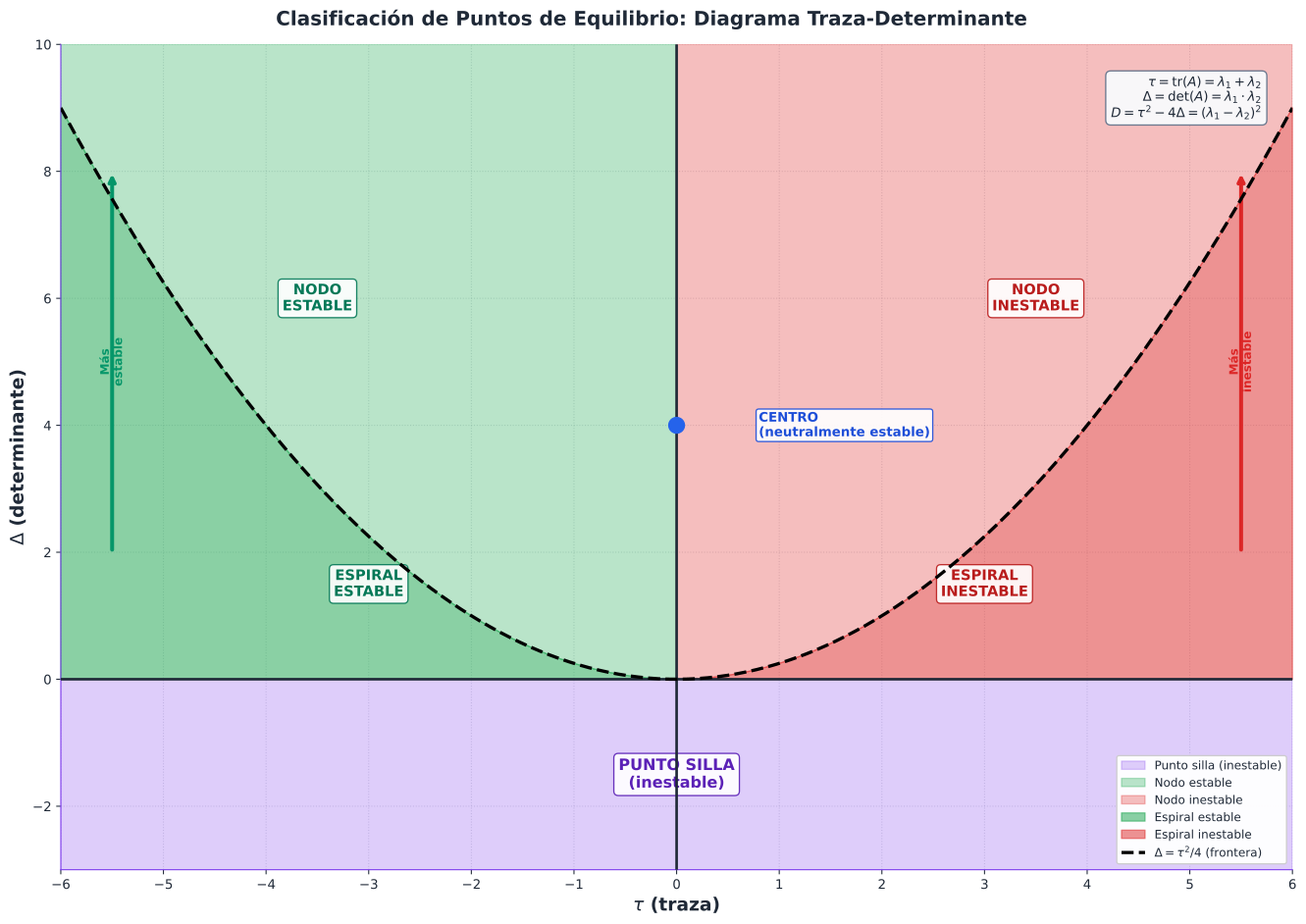
Traza y Determinante
Para $A = \begin{pmatrix} a & b \ c & d \end{pmatrix}$:
- $\tau = \text{tr}(A) = a + d = \lambda_1 + \lambda_2$
- $\Delta = \det(A) = ad - bc = \lambda_1 \lambda_2$
- Discriminante: $\tau^2 - 4\Delta$
| Región | Tipo |
|---|---|
| $\Delta < 0$ | Silla |
| $\Delta > 0$, $\tau^2 > 4\Delta$, $\tau < 0$ | Nodo estable |
| $\Delta > 0$, $\tau^2 > 4\Delta$, $\tau > 0$ | Nodo inestable |
| $\Delta > 0$, $\tau^2 < 4\Delta$, $\tau < 0$ | Espiral estable |
| $\Delta > 0$, $\tau^2 < 4\Delta$, $\tau > 0$ | Espiral inestable |
| $\Delta > 0$, $\tau = 0$ | Centro |
3.6 Matriz Exponencial
Definición
$$e^{At} = I + At + \frac{(At)^2}{2!} + \frac{(At)^3}{3!} + \cdots = \sum_{k=0}^{\infty} \frac{(At)^k}{k!}$$
Solución del PVI
Para $\mathbf{X}' = A\mathbf{X}$ con $\mathbf{X}(0) = \mathbf{X}_0$:
$$\boxed{\mathbf{X}(t) = e^{At}\mathbf{X}_0}$$
Cálculo mediante Diagonalización
Si $A = PDP^{-1}$ donde $D = \text{diag}(\lambda_1, ..., \lambda_n)$:
$$e^{At} = Pe^{Dt}P^{-1}$$
donde $e^{Dt} = \text{diag}(e^{\lambda_1 t}, ..., e^{\lambda_n t})$
Propiedades
- $e^{0} = I$
- $\frac{d}{dt}e^{At} = Ae^{At}$
- $e^{A(t+s)} = e^{At}e^{As}$
- $(e^{At})^{-1} = e^{-At}$
Ejemplo: Calcular $e^{At}$ para $A = \begin{pmatrix} 1 & 1 \ 0 & 2 \end{pmatrix}$
Eigenvalores: $\lambda_1 = 1$, $\lambda_2 = 2$
Eigenvectores: $\mathbf{v}_1 = \begin{pmatrix} 1 \ 0 \end{pmatrix}$, $\mathbf{v}_2 = \begin{pmatrix} 1 \ 1 \end{pmatrix}$
$P = \begin{pmatrix} 1 & 1 \ 0 & 1 \end{pmatrix}$, $P^{-1} = \begin{pmatrix} 1 & -1 \ 0 & 1 \end{pmatrix}$
$$e^{At} = \begin{pmatrix} 1 & 1 \ 0 & 1 \end{pmatrix}\begin{pmatrix} e^t & 0 \ 0 & e^{2t} \end{pmatrix}\begin{pmatrix} 1 & -1 \ 0 & 1 \end{pmatrix}$$
$$e^{At} = \begin{pmatrix} e^t & e^{2t} - e^t \ 0 & e^{2t} \end{pmatrix}$$