Teoría — Vectores en el espacio
1.1 Definición de un vector en el plano y en el espacio
Concepto intuitivo
Un vector es un objeto matemático que tiene magnitud (longitud) y dirección. Geométricamente se representa como una flecha que va de un punto inicial a un punto final.
Representación en coordenadas
- En el plano $\mathbb{R}^2$: $\mathbf{v} = \langle v_x, v_y \rangle$
- En el espacio $\mathbb{R}^3$: $\mathbf{v} = \langle v_x, v_y, v_z \rangle$
Las componentes $v_x, v_y, v_z$ indican cuánto "avanza" el vector en cada eje coordenado.
Vector posición
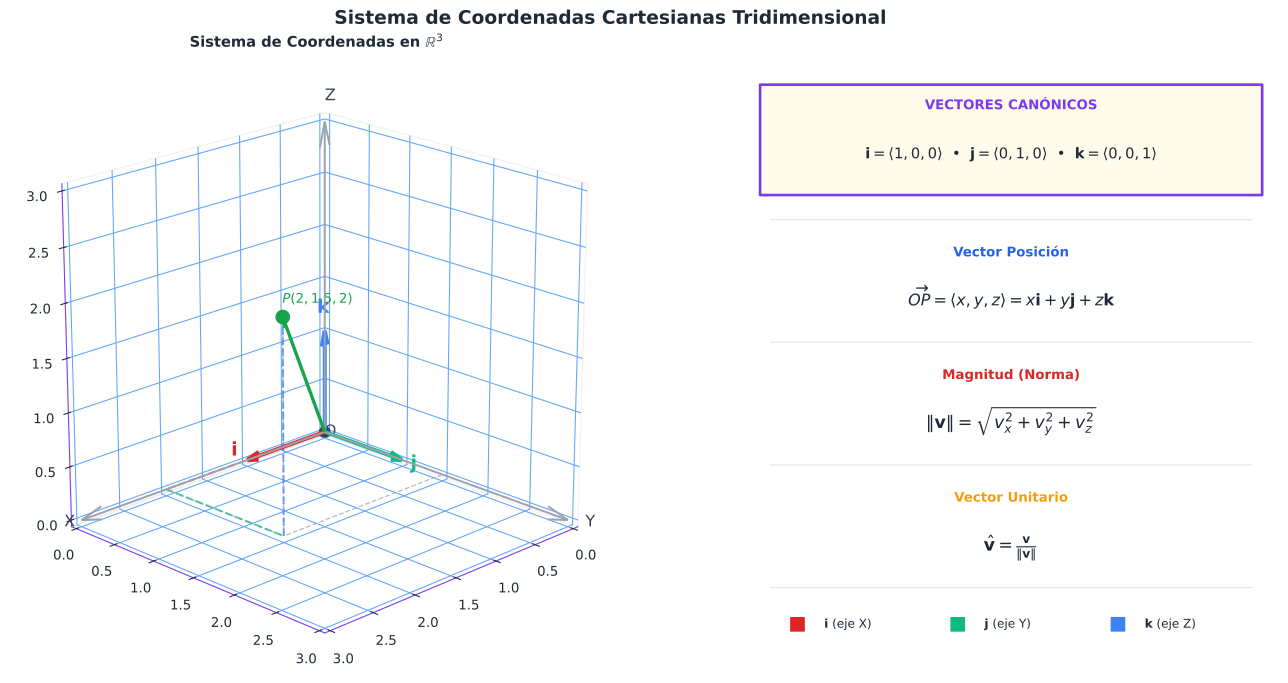
Dado un punto $P = (a, b, c)$, el vector posición $\overrightarrow{OP}$ va del origen al punto: $$\overrightarrow{OP} = \langle a, b, c \rangle$$
Vector entre dos puntos
Si $A = (a_1, a_2, a_3)$ y $B = (b_1, b_2, b_3)$: $$\overrightarrow{AB} = \langle b_1 - a_1, b_2 - a_2, b_3 - a_3 \rangle$$
Interpretación geométrica
- Magnitud: longitud del segmento.
- Dirección: orientación en el espacio, determinada por los ángulos que forma con los ejes.
- Sentido: de la cola a la punta de la flecha.
Magnitud (norma)
$$\lVert \mathbf{v} \rVert = \sqrt{v_x^2 + v_y^2 + v_z^2}$$
Vector unitario
Un vector con magnitud 1. Para cualquier $\mathbf{v} \neq \mathbf{0}$: $$\hat{\mathbf{v}} = \frac{\mathbf{v}}{\lVert \mathbf{v} \rVert}$$
Vectores canónicos
En $\mathbb{R}^3$: $\mathbf{i} = \langle 1,0,0 \rangle$, $\mathbf{j} = \langle 0,1,0 \rangle$, $\mathbf{k} = \langle 0,0,1 \rangle$.
Todo vector se escribe como: $$\mathbf{v} = v_x\mathbf{i} + v_y\mathbf{j} + v_z\mathbf{k}$$
Figura 1.1.1: Sistema de coordenadas tridimensional con los ejes $x$, $y$, $z$ y los vectores canónicos $\mathbf{i}$, $\mathbf{j}$, $\mathbf{k}$.
1.2 Álgebra vectorial y su geometría
Suma de vectores
$$\mathbf{u} + \mathbf{v} = \langle u_x + v_x, u_y + v_y, u_z + v_z \rangle$$
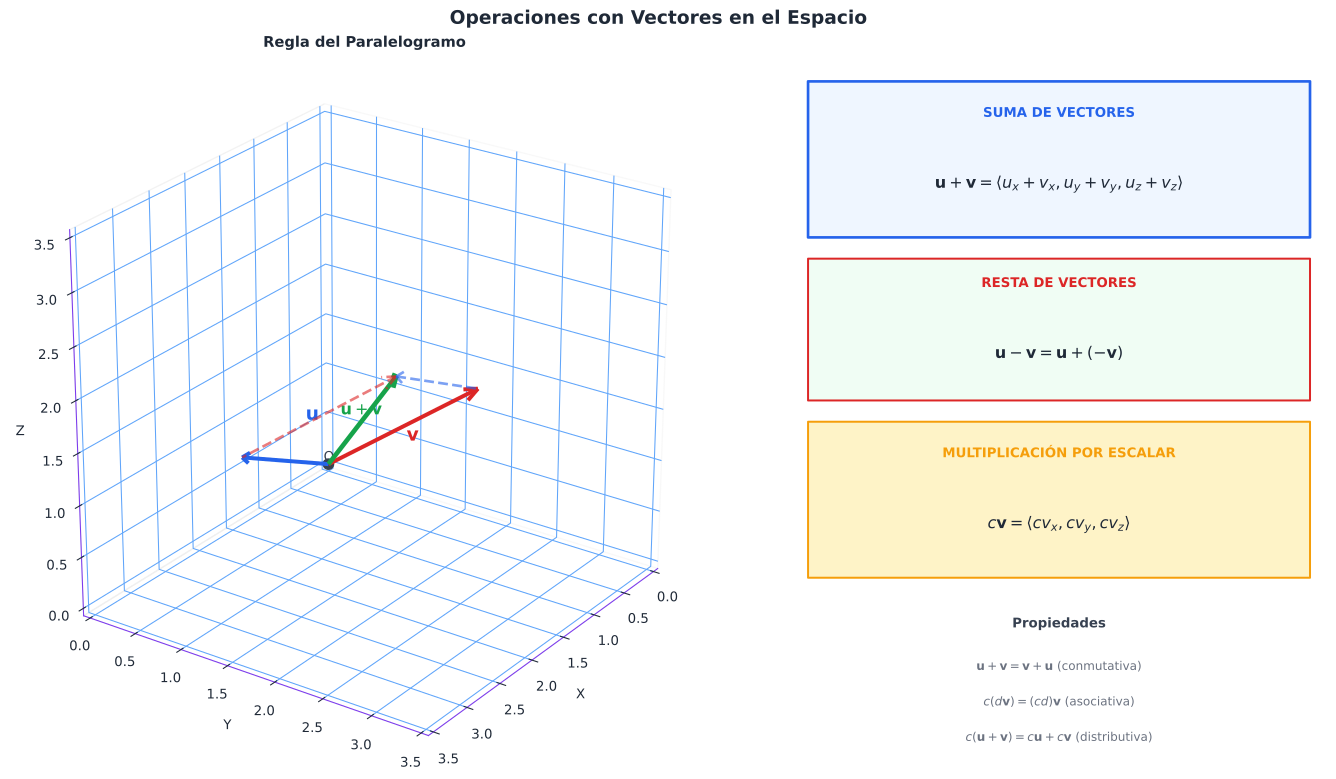
Interpretación geométrica (regla del paralelogramo): coloca los vectores con el mismo origen; la diagonal del paralelogramo que forman es $\mathbf{u} + \mathbf{v}$.
Regla cabeza-cola: coloca la cola de $\mathbf{v}$ en la punta de $\mathbf{u}$; el resultado va del origen de $\mathbf{u}$ a la punta de $\mathbf{v}$.
Resta de vectores
$$\mathbf{u} - \mathbf{v} = \mathbf{u} + (-\mathbf{v})$$
Geométricamente, $-\mathbf{v}$ es el vector opuesto (misma magnitud, dirección contraria).
Multiplicación por escalar
$$c\mathbf{v} = \langle cv_x, cv_y, cv_z \rangle$$
- Si $c > 0$: mismo sentido, magnitud escalada por $c$.
- Si $c < 0$: sentido opuesto.
- Si $c = 0$: vector nulo $\mathbf{0}$.
Propiedades del álgebra vectorial
| Propiedad | Expresión |
|---|---|
| Conmutativa | $\mathbf{u} + \mathbf{v} = \mathbf{v} + \mathbf{u}$ |
| Asociativa | $(\mathbf{u} + \mathbf{v}) + \mathbf{w} = \mathbf{u} + (\mathbf{v} + \mathbf{w})$ |
| Neutro aditivo | $\mathbf{v} + \mathbf{0} = \mathbf{v}$ |
| Inverso aditivo | $\mathbf{v} + (-\mathbf{v}) = \mathbf{0}$ |
| Distributiva escalar | $c(\mathbf{u} + \mathbf{v}) = c\mathbf{u} + c\mathbf{v}$ |
Combinación lineal
Dados vectores $\mathbf{v}_1, \mathbf{v}_2, \ldots, \mathbf{v}_n$ y escalares $c_1, c_2, \ldots, c_n$: $$c_1\mathbf{v}_1 + c_2\mathbf{v}_2 + \cdots + c_n\mathbf{v}_n$$
Aplicación: dos vectores no paralelos generan un plano; tres vectores no coplanares generan todo $\mathbb{R}^3$.
Vectores paralelos
$\mathbf{u} \parallel \mathbf{v}$ si existe $k \in \mathbb{R}$ tal que $\mathbf{u} = k\mathbf{v}$.
Figura 1.2.1: Suma de vectores (regla del paralelogramo) y multiplicación por escalar en el espacio tridimensional.
1.3 Producto escalar y vectorial
Producto escalar (producto punto)
Definición algebraica: $$\mathbf{u} \cdot \mathbf{v} = u_x v_x + u_y v_y + u_z v_z$$
Definición geométrica: $$\mathbf{u} \cdot \mathbf{v} = \lVert \mathbf{u} \rVert \lVert \mathbf{v} \rVert \cos\theta$$
donde $\theta$ es el ángulo entre los vectores.
Propiedades clave: - $\mathbf{u} \cdot \mathbf{v} = 0 \iff \mathbf{u} \perp \mathbf{v}$ (ortogonales) - $\mathbf{v} \cdot \mathbf{v} = \lVert \mathbf{v} \rVert^2$
Ángulo entre vectores: $$\cos\theta = \frac{\mathbf{u} \cdot \mathbf{v}}{\lVert \mathbf{u} \rVert \lVert \mathbf{v} \rVert}$$
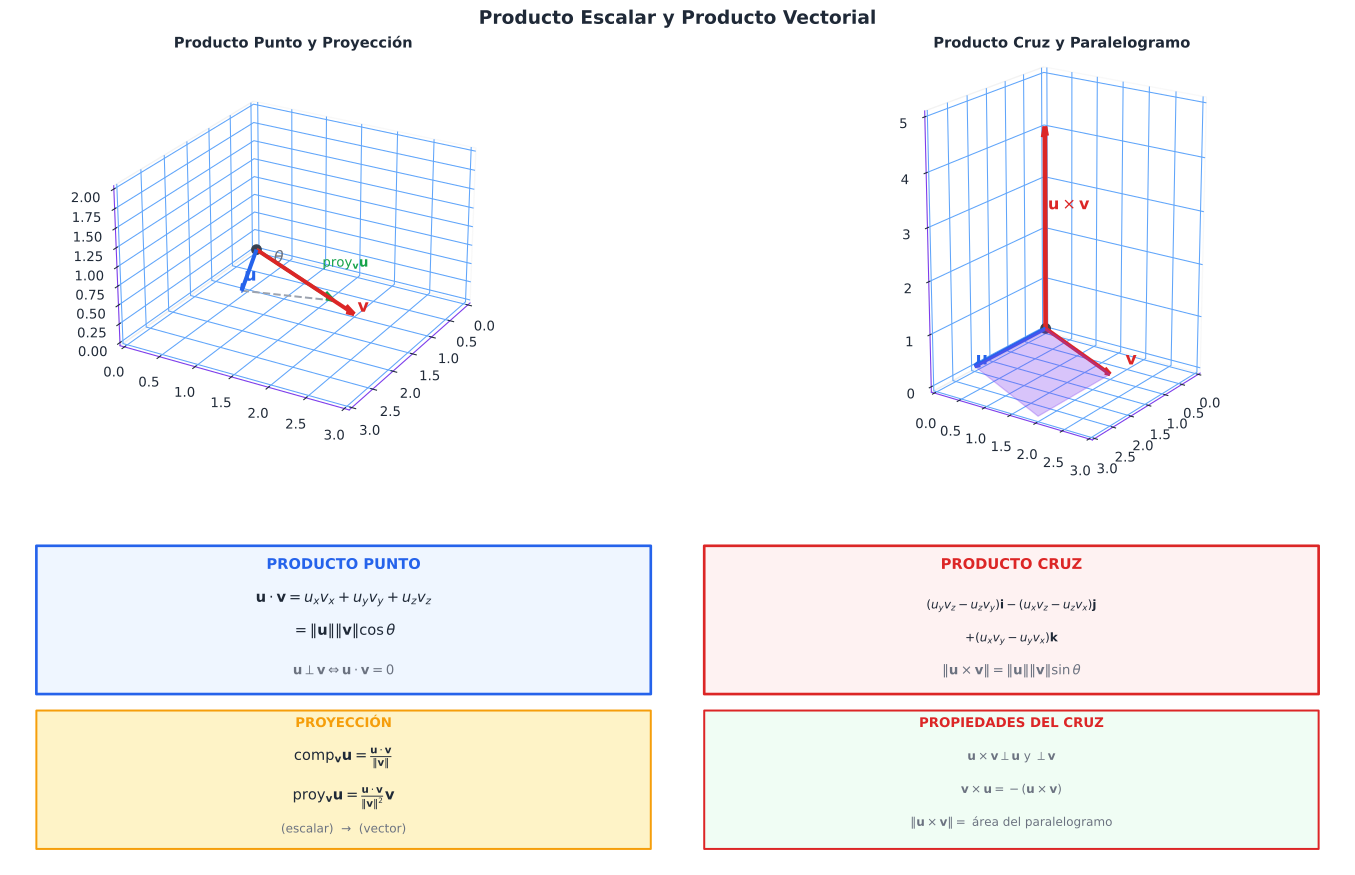
Proyección de $\mathbf{u}$ sobre $\mathbf{v}$: $$\text{comp}{\mathbf{v}}\mathbf{u} = \frac{\mathbf{u} \cdot \mathbf{v}}{\lVert \mathbf{v} \rVert} \quad \text{(escalar)}$$ $$\text{proy}{\mathbf{v}}\mathbf{u} = \frac{\mathbf{u} \cdot \mathbf{v}}{\lVert \mathbf{v} \rVert^2}\mathbf{v} \quad \text{(vector)}$$
Producto vectorial (producto cruz)
Solo en $\mathbb{R}^3$. El resultado es un vector.
Definición mediante determinante: $$\mathbf{u} \times \mathbf{v} = \begin{vmatrix} \mathbf{i} & \mathbf{j} & \mathbf{k} \ u_x & u_y & u_z \ v_x & v_y & v_z \end{vmatrix}$$
Expandiendo: $$\mathbf{u} \times \mathbf{v} = \langle u_y v_z - u_z v_y, \; u_z v_x - u_x v_z, \; u_x v_y - u_y v_x \rangle$$
Propiedades geométricas: - $\mathbf{u} \times \mathbf{v}$ es ortogonal a $\mathbf{u}$ y a $\mathbf{v}$. - Dirección dada por la regla de la mano derecha. - $\lVert \mathbf{u} \times \mathbf{v} \rVert = \lVert \mathbf{u} \rVert \lVert \mathbf{v} \rVert \sin\theta$ = área del paralelogramo.
Propiedades algebraicas: - Anticonmutativo: $\mathbf{v} \times \mathbf{u} = -(\mathbf{u} \times \mathbf{v})$ - $\mathbf{u} \times \mathbf{u} = \mathbf{0}$ - $\mathbf{u} \times \mathbf{v} = \mathbf{0} \iff \mathbf{u} \parallel \mathbf{v}$
Producto triple escalar
$$\mathbf{u} \cdot (\mathbf{v} \times \mathbf{w}) = \det \begin{pmatrix} u_x & u_y & u_z \ v_x & v_y & v_z \ w_x & w_y & w_z \end{pmatrix}$$
Su valor absoluto es el volumen del paralelepípedo formado por los tres vectores.
Figura 1.3.1: Interpretación geométrica del producto escalar (proyección) y producto vectorial (área del paralelogramo, vector perpendicular).
1.4 Ecuación de la recta
Forma vectorial
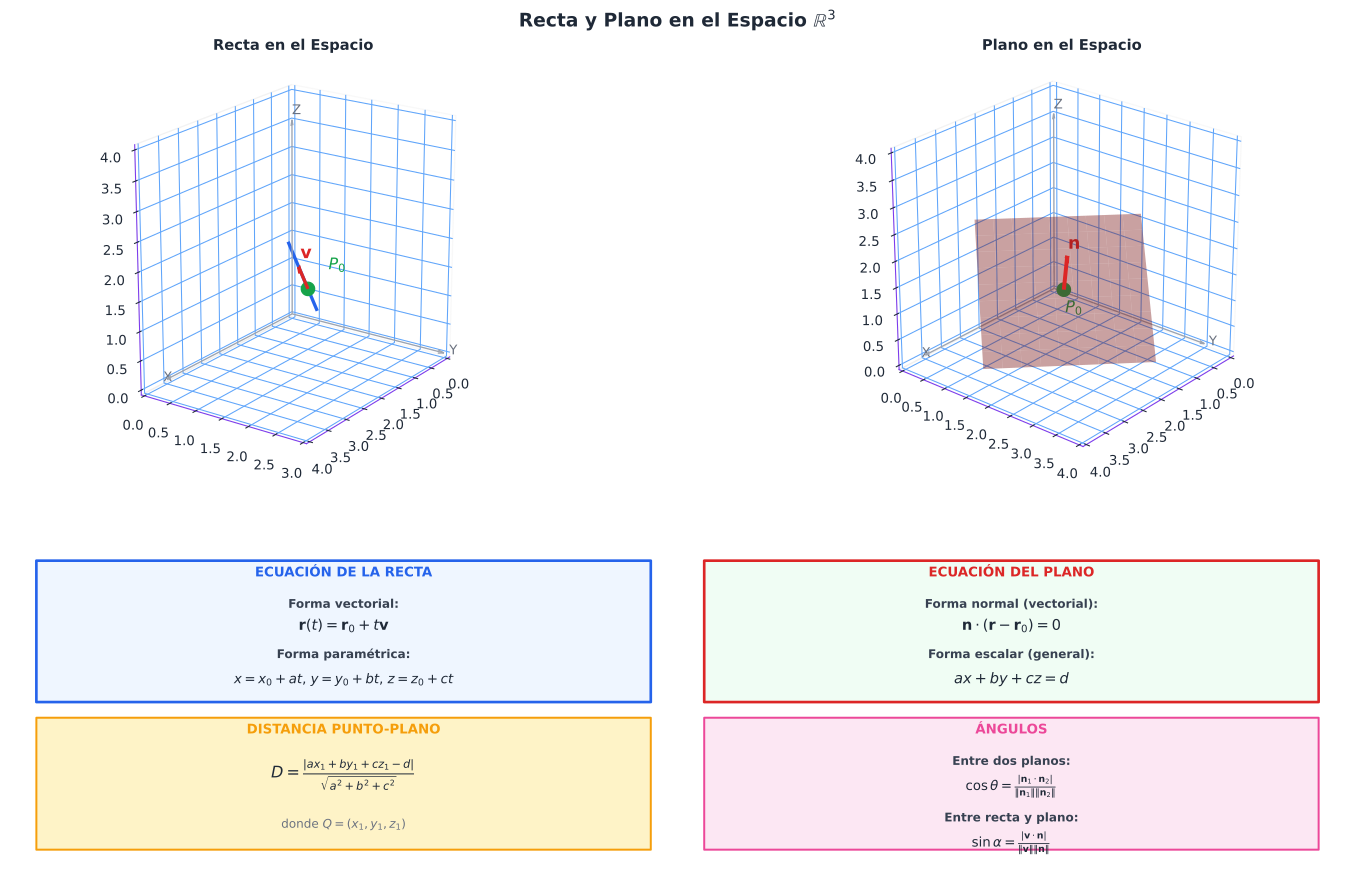
Una recta pasa por $P_0 = (x_0, y_0, z_0)$ con dirección $\mathbf{v} = \langle a, b, c \rangle$: $$\mathbf{r}(t) = \mathbf{r}_0 + t\mathbf{v} = \langle x_0 + at, \; y_0 + bt, \; z_0 + ct \rangle$$
donde $t \in \mathbb{R}$ es el parámetro.
Forma paramétrica
$$\begin{cases} x = x_0 + at \ y = y_0 + bt \ z = z_0 + ct \end{cases}$$
Forma simétrica (si $a, b, c \neq 0$)
$$\frac{x - x_0}{a} = \frac{y - y_0}{b} = \frac{z - z_0}{c}$$
Recta por dos puntos
Dados $A$ y $B$, dirección $\mathbf{v} = \overrightarrow{AB}$, recta: $\mathbf{r}(t) = A + t\overrightarrow{AB}$.
Posiciones relativas de dos rectas
- Paralelas: direcciones proporcionales.
- Coincidentes: paralelas y comparten un punto.
- Secantes: se cruzan en un punto (resolver sistema).
- Alabeadas (en 3D): ni paralelas ni secantes.
1.5 Ecuación del plano
Forma normal (vectorial)
Un plano con punto $P_0 = (x_0, y_0, z_0)$ y vector normal $\mathbf{n} = \langle a, b, c \rangle$: $$\mathbf{n} \cdot (\mathbf{r} - \mathbf{r}_0) = 0$$
Forma escalar (general)
$$ax + by + cz = d$$ donde $d = ax_0 + by_0 + cz_0$.
El vector $\mathbf{n} = \langle a, b, c \rangle$ es normal al plano.
Plano por tres puntos no colineales
Dados $A$, $B$, $C$: 1. Calcula $\overrightarrow{AB}$ y $\overrightarrow{AC}$. 2. Normal: $\mathbf{n} = \overrightarrow{AB} \times \overrightarrow{AC}$. 3. Usa cualquiera de los tres puntos en la ecuación.
Distancia de un punto a un plano
Dado el plano $ax + by + cz = d$ y el punto $Q = (x_1, y_1, z_1)$: $$D = \frac{|ax_1 + by_1 + cz_1 - d|}{\sqrt{a^2 + b^2 + c^2}}$$
Ángulo entre dos planos
Si los planos tienen normales $\mathbf{n}_1$ y $\mathbf{n}_2$: $$\cos\theta = \frac{|\mathbf{n}_1 \cdot \mathbf{n}_2|}{\lVert \mathbf{n}_1 \rVert \lVert \mathbf{n}_2 \rVert}$$
Ángulo entre recta y plano
Si la recta tiene dirección $\mathbf{v}$ y el plano normal $\mathbf{n}$: $$\sin\alpha = \frac{|\mathbf{v} \cdot \mathbf{n}|}{\lVert \mathbf{v} \rVert \lVert \mathbf{n} \rVert}$$
Figura 1.5.1: Representación de rectas y planos en el espacio 3D, mostrando vectores directores, vectores normales e intersecciones.